

Kid A
Ice age coming. Ice age coming. Let me see both sides.

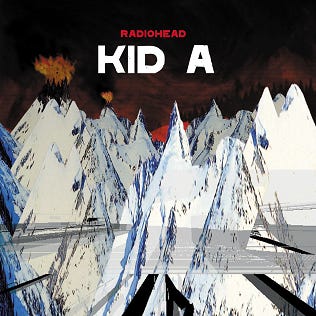
Before I go into my article, I want to bring up that anyone who is really into this record may want to check out a book I read a few years ago. It was written by Steven Hyden called “This Isn’t Happening: Radiohead’s Kid A and the Beginning of the 21st Century. I found it to be a great read.
Hi Son,
A little over a year ago I told you about how I finally gave Radiohead a chance when I obtained “In Rainbows.” For a long while I had avoided them and constantly talked shit on them, mainly because I had just heard their music was “depressing.” A lot of what I avoided twenty years ago I considered depressing. I don’t consider “depressing” to be a bad thing anymore. Especially since I am someone who has dealt with it for longer than I can remember. It wasn’t until after what your mom went through 8 years ago that I took steps to get help. When I listen to something that I would have considered “depressing” in my younger age it’s therapeutic. What I struggled for so long in my life was understand why I felt the way I did. Putting a name to my struggle, especially through music, has empowered me in a lot of ways. Knowing exactly what I’m running from or fighting with grounds me from spiraling out. Back when I immersed myself in Radiohead’s catalog, there was one record of theirs that I still struggled with. It would arguably be the biggest pivot point in Radiohead’s career. That record is “Kid A.”
Coming off of what I consider to be their masterpiece, “OK Computer,” the band was at a crossroad. What I found interesting about that is they already moved significantly toward an abstract interpretation of Alternative music. Thom was actually struggling mightily with Writer’s Block and felt that the genre of rock music had run it’s course. He looked into electronic music and was quoted saying:
"It was refreshing because the music was all structures and had no human voices in it. But I felt just as emotional about it as I'd ever felt about guitar music.”
Thom’s vocals are very distinct and at that point of his career really stood out from the music. What he wanted to explore was having his vocals as part of the music. His voice being more of a musical instrument. The band bought a barn in Oxfordshire that they would come to use as a recording studio. There was no deadline on their next record. However, the others in the band were really concerned about the direction Thom wanted to take things.

The band would begin experimenting with electronic instruments and Pro Tools, which was fairly new at that time. Ed was actually really struggling with the idea of electronic instruments. As the lead guitarist, how could he continue to do what he did best by resorting to electronic instruments? A big part of what made him come around was a suggestion their producer, Nigel Godrich, came up with. Split the band into two separate groups. “One would generate a sound or sequence without acoustic instruments such as guitars or drums, and the other would develop it.” This did not result in any finished songs, but made Ed come around to the idea of electronic instruments. In total the band produced over 20 songs. Rather than release a double album, they chose to leave several off to be released as a separate record. They would use 10 of them to be released on “Kid A.” There was a lot conflict on choosing those songs. It almost cause the band to break up. Luckily it didn’t and on October 2, 2000, “Kid A” was made available to the world.
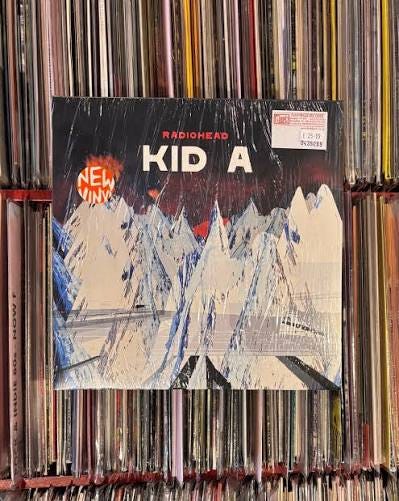
As I stated earlier, “Kid A” was the last of their discography (ca. 2006) that I really grasped onto. The first time I listened to it felt like a lot noise. Thom’s vocals were distorted in several songs and a lot of the music did not seem coherent. There was one track I was familiar with (Idioteque) only because they played the music video from it in the student union of my undergraduate school. The first track, “Everything in it’s Right Place” was actually somewhat straightforward. The music is pretty much distorted sound with what seems to be a keyboard. Thom is repeating consistently, “Everything. Everything. Everything. Everything” then “In it’s right place” four times in a row. For the most part, the same line would be repeated over-and-over:
“Yesterday, I woke up sucking a lemon.”
“There are two colours in my head.”
“What is it you tried to say?”
Those are pretty much the words to the whole song. The feeling it gave me initially was discomfort. It made me somewhat nervous, but also skeptical, of what was to come next.

Track two was very strange. It was the title track, “Kid A.” Again, a lot of the music a departure from the guitars you would have been accustomed to. What stands out the most is Thom’s vocals. It sounds like he has sunken into a void and is trying to sing through it. The words are very hard to discern. What I would learn is he sung “through a Vocoder-like filter and using a Ondes Martenot, a keyboard like instrument, to control the pitch of the filter, to simulate singing.” Looking back I can’t imagine how challenging that was to get the result they produced. Track three, “National Anthem,” is bat shit crazy. It starts with a really cool bass guitar riff coming from Colin. Then Phil comes in with drums. Honestly, if they just played 30 seconds on loop, it would have kept me engaged. Thom then begins singing with more voice distortion and a feedback echo. This continues until about halfway through the song, all of a sudden a bunch of brass and woodwind instruments start blaring. It starts off sounding coherent and then begins to go completely bat shit. The horns keep getting louder until the bridge where they completely back off. Then a trumpet starts playing random notes and it keeps getting weirder and weirder until the end, where the entire ensemble just seemingly blows random notes as loud as they can until the end.

Track four is probably the most emotional and depressing song on the record, “How to Disappear Completely.” Thom doesn’t use distorted vocals on this song. The music is very melancholy. The story of the song is that Thom had a dream of floating around the city as a ghost. When you listen to the words you can easily see that impression. When I think about what the song means to me, it takes on a different meaning. It’s something I feel a lot. When I am in a state of deep depression, the one image I have more than anything is just dropping everything at that moment and going off as far away as possible from where I originally stood. No one else around me. Just somewhere that I can be completely alone and physically far away as I can from my life. This is what I’m talking about when I put meaning to my sadness. The song speaks to me more than any other song on “Kid A” by a long shot. While this track is sad and depressing, it’s also beautiful. Thom’s voice is emotionally strained and honestly I can’t think of another vocalist who does that better than him.
“Treefingers” is next. It is an instrumental track. On the surface this track almost sounds like an intermission. For a long time that’s how it felt to me when I got to it. That changed not too long ago. When I hear this song the feeling that comes to me is someone who is looking around and is admiring the imagery without having full understanding. The perspective I imagine going through this experience is one seeing the world for the first time. I think about the day you were born. When you were being taken around the delivery room without any idea of what was happening to you. Instead of hearing voices, machines or other sounds in the room, everything sounded like what “Treefingers” is. The song almost stops me in my tracks when I hear it now. Track six is “Optimistic.” This is probably the most uplifting song on the record. The music is maybe the most straightforward out of any of the tracklist. Again, no distortion to Thom’s lyrics. The words he sings just resonate with you. “You can try the best you can. You can try the best you can. The best you can is good enough.” It’s a reminder that it’s okay to not succeed, as long as you gave it your best.

Track seven is “In Limbo.” I find this to be a fairly euphoric song. It has a cool keyboard riff throughout. Then we get to the aforementioned song that I first experience from it’s music video. Track eight is “Idioteque.” The music throughout is a drum machine pattern that Jonny created using a modular synthesizer. The song mostly just Jonny’s creation on the synthesizer with Thom singing. When you watch the video, or anytime they perform the song live, Jonny is moving around wires to get the sound used in the background. Vocally, I feel like Thom gets into this song as much as any in Radiohead’s catalog. The best part of the lyric is when he starts emphatically singing “Ice age coming! Ice age coming! Let me hear both sides! Let me hear both.” After the lyrics are finished and the music begins it’s outro, Thom starts dancing manically! It’s become one of their staples when they tour and is probably the most popular track on “Kid A.”
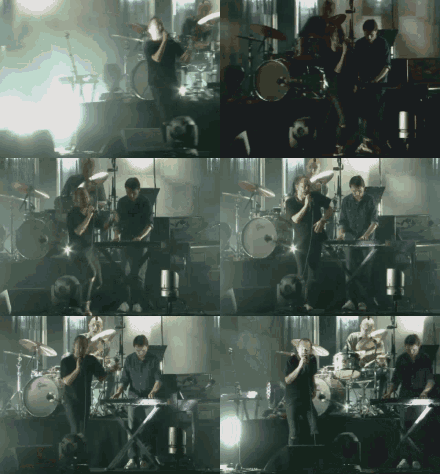
Track nine is “Morning Bell.” This is a beautiful yet haunting song when I hear it. It starts off sounding kind of like the sun is rising over the horizon. “The morning bell. Light another candle and release me.” However, it gets dark all the way to the bridge where Thom sings “cut the kids in half.” Many interpret this song being about a divorce. I almost feel like this is someone walking out into a deserted area after the zombie apocalypse had occurred. Regardless of my feelings, it is really well placed. It has a great feel as the penultimate song of the tracklist. Finally we get to the last track, “Motion Picture Soundtrack.” The song was actually written in the early 90s. It starts off with Thom singing to a pedal organ, but then starts building in a harp and a double bass. This is a fantastic closer, mostly because it feels like the last song in a fairy tale. The lyrics however are anything but a “happily ever after.” The meaning of the words “muses over lost love and deep sadness.” Where the last line of the song is “I will see you in the next life.” It’s a goodbye. Whether you want to feel Thom’s sentiment of letting go of love, or you could feel as if the record itself is telling the listener goodbye.

After reading all of my impressions, it would seem like a lot of this record is just too out there for me. However, it has grown on me over time. You have to experience “Kid A” in its totality. There is maybe one song you could consider a single and just play it by itself (Idioteque). When you experence “Kid A” and begin to appreciate it you find that every song needs the song before and after it. I think the sequencing of this song is nearly perfect. Although someone who has become of my favorite writers would propose a different sequence. Earlier I said that “OK Computer” was Radiohead’s masterpiece. Although after being with their music for almost two decades, I believe “Kid A” to be seminal work of the band.
Love,
Dad
I’m not charging for subscriptions, but if you do want to pledge:
buymeacoffee.com/brainofjayhawk

“What I struggled for so long in my life was understand why I felt the way I did. Putting a name to my struggle, especially through music, has empowered me in a lot of ways.”
I can totally relate to this, friend. Music has saved me so many times. (Also I tried to share this quote but Substack is wonky and won’t let me ☹️)
Excellent album walk thru. It definitely takes me back to October 2000 and just being utterly blown away by this album and this band. It’s still a go-to for me when I’m feeling melancholy, or just slightly exhausted. I think of “Optimistic,” “In Limbo,” and “Idioteque” as a song suite, as they flow together. And I love the pairing of “Morning Bell” with the sped up Amnesiac version, too. This is one of my all time top 5 favourite albums!!